How APT Groups Evade Detection in a SOC
Advanced Persistent Threats (APTs) represent some of the most sophisticated and dangerous cyber adversaries in the world. Unlike opportunistic attackers or commodity malware campaigns, APT groups are well-funded, highly skilled, and extremely patient. Their goal is not a quick win, it is long-term access, data exfiltration, or strategic disruption.
For Security Operations Centers (SOCs), detecting APT activity is one of the hardest challenges. These attackers know how SOCs operate, and they deliberately design their techniques to blend in with normal network traffic, bypass standard detection tools, and remain unnoticed for months or even years.
Let’s explore the primary ways APT groups evade detection in a SOC, and what defenders can do to counter them.
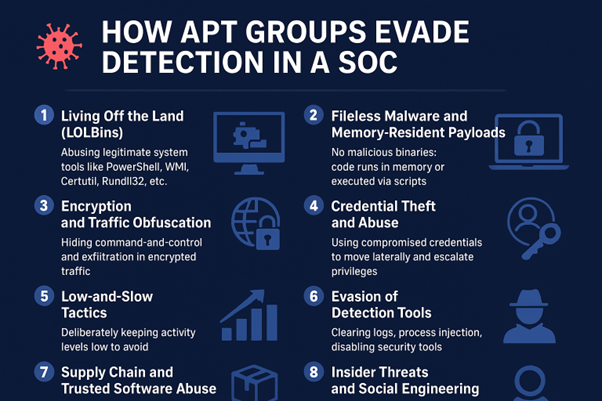
1. Living Off the Land (LOLBins)
APT groups frequently abuse legitimate system tools, often called Living-off-the-Land Binaries (LOLBins). Instead of deploying custom malware that could be flagged by antivirus or EDR solutions, they use built-in utilities like:
- PowerShell – executing scripts and downloading payloads
- WMI (Windows Management Instrumentation) – persistence and remote execution
- Certutil – encoding/decoding and transferring files
- Rundll32 – running malicious code via DLLs
Because these tools are part of the operating system, their execution doesn’t immediately appear suspicious. To a SOC analyst looking at logs, activity may resemble normal administrative behavior.
Why it works: SOCs struggle to distinguish between legitimate admin activity and malicious abuse of system tools.
2. Fileless Malware and Memory-Resident Payloads
Rather than writing malicious binaries to disk (where antivirus or EDR may detect them), APTs often operate entirely in memory. They inject code directly into legitimate processes or use scripting languages (like PowerShell or Python) to execute payloads dynamically.
Example:
APT29 (Cozy Bear) has been observed using memory-resident implants that vanish once a system reboots, leaving almost no forensic trace.
Why it works: Traditional detection methods rely on scanning files on disk. Fileless techniques drastically reduce the footprint available for SOC tools to analyze.
3. Encryption and Traffic Obfuscation
Modern SOCs rely heavily on network monitoring to spot malicious traffic. APTs counter this by encrypting or disguising their communications.
- Using HTTPS or TLS to hide command-and-control (C2) traffic inside normal web browsing patterns
- Leveraging cloud services (e.g., Dropbox, Google Drive, OneDrive) as exfiltration channels
- Domain fronting, where attackers hide C2 traffic behind trusted domains like Microsoft or Google
Why it works: To a SOC, encrypted outbound traffic to cloud platforms looks identical to normal user activity. Without deep inspection, malicious traffic blends perfectly.
4. Credential Theft and Abuse
APTs often compromise legitimate user accounts instead of creating new ones. Once they have valid credentials, they can move laterally, escalate privileges, and exfiltrate data, all under the guise of a trusted employee.
- Pass-the-Hash or Pass-the-Ticket attacks let them impersonate users without knowing their passwords
- Privileged accounts (like domain admins) are especially targeted for stealthy persistence
Why it works: SOC detection rules are often focused on failed logins, brute-force attempts, or unusual account creation. But if the attacker is using legitimate credentials, their activity can appear completely normal.
5. Low-and-Slow Tactics
Unlike ransomware actors who create noise, APTs play the long game. They deliberately keep activity levels low to avoid triggering alerts.
- Exfiltrating data in small chunks over weeks or months
- Spacing out commands to avoid suspicious spikes in activity
- Operating during regular business hours to blend in with normal network traffic
Why it works: Most SOCs tune detection systems to identify abnormal spikes or bursts of malicious behavior. Slow, consistent activity often flies under the radar.
6. Supply Chain and Trusted Software Abuse
APT groups increasingly compromise software vendors, IT providers, or managed services to infiltrate targets indirectly.
The SolarWinds attack (attributed to APT29) is a prime example: attackers compromised an update mechanism, pushing signed malicious code to thousands of customers.
Why it works: SOCs generally trust updates signed by legitimate vendors. Malicious behavior originating from a trusted source is extremely hard to flag without advanced behavioral monitoring.
7. Evasion of Detection Tools
APTs actively study SOC technologies like SIEM, EDR, and AV to craft evasion strategies.
- Log tampering: Clearing or modifying event logs to erase traces of activity
- Process injection: Running code inside trusted processes (like explorer.exe or svchost.exe)
- Disabling security tools: Shutting down EDR agents or tampering with Windows Event Logging
Why it works: If the SOC’s visibility is reduced, analysts may miss critical parts of the attack chain.
8. Insider Threats and Social Engineering
Some APTs bypass technical detection entirely by exploiting the human element.
- Recruiting insiders to provide credentials or disable monitoring
- Using spear-phishing emails tailored so precisely they appear legitimate
- Deploying malware via removable media or direct insider access
Why it works: SOCs can defend against malicious code, but defending against a trusted employee acting maliciously is far more complex.
Countermeasures: How SOCs Can Respond
While APTs are formidable, they are not invisible. SOCs can strengthen detection with:
- Behavioral Analytics – focus on deviations in user or system behavior rather than static signatures.
- Threat Hunting – proactively search for anomalies in logs and endpoints instead of waiting for alerts.
- Threat Intelligence Integration – use IOCs and TTPs from frameworks like MITRE ATT&CK to spot attacker patterns.
- Deception Technologies – deploy honeypots, honeytokens, or decoy accounts to lure attackers and reveal their presence.
- Zero Trust Architecture – minimize reliance on implicit trust, even for internal accounts or services.
- Continuous Training – upskill SOC analysts to recognize advanced techniques and not rely solely on automated alerts.
Conclusion
APT groups evade SOC detection by mastering stealth: abusing legitimate tools, operating in memory, hiding traffic in encrypted channels, stealing credentials, and carefully pacing their operations. They study defenders as much as defenders study them.
For SOC teams, the key lesson is that prevention alone is not enough. Detection must evolve from static rules to adaptive, intelligence-driven, and behavior-focused strategies.
In the arms race between attackers and defenders, APTs thrive on invisibility. SOCs must respond by shining light in the darkest corners of their networks and staying vigilant against the threats designed to hide in plain sight.