Introduction
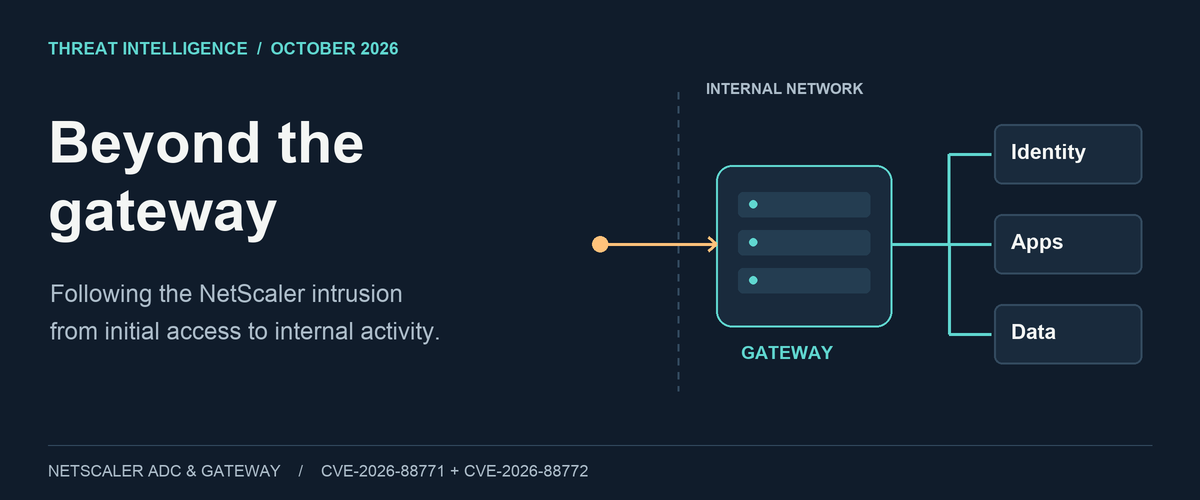
The gateway is patched. Remote access works again. The emergency change is closed. One question still needs an answer: what happened while the appliance was vulnerable?
September’s NetScaler disclosures make that question particularly relevant. Citrix confirmed exploitation of two vulnerabilities before customers could install the fixes. For a SOC, the job extends beyond checking a version number. It means finding out whether someone established an independent way back in, and whether they used the gateway to reach anything else.
This article examines public research available on 2 October 2026. The intrusion observations belong to the researchers cited below; the investigation priorities are our analysis of their findings.
Two vulnerabilities, different conditions
Citrix’s 27 September bulletin covers eight vulnerabilities. Two of them, CVE-2026-88771 and CVE-2026-88772, were already being exploited. Each can independently allow remote code execution without authentication.
The first is an input-validation flaw affecting vulnerable NetScaler ADC and Gateway deployments, including default configurations. The second is a memory-corruption flaw whose exposure depends on DTLS, the datagram-based transport security protocol enabled by default on VPN virtual servers. They should not be described as a mandatory two-step exploit chain.
Citrix lists fixes in 14.1-73.37 and 13.1-64.23 for the standard release branches. FIPS and NDcPP deployments have their own entries in the bulletin. Match the actual edition and branch before selecting an update.
That distinction also belongs in incident records. “NetScaler exploitation” is useful as an initial label, but it does not tell an analyst which entry point to investigate or which temporary restriction would help.
The intrusion started before the announcement
Mandiant and Google Threat Intelligence Group place the activity associated with CVE-2026-88772 at least as far back as early September. Their assessment includes likely affected organizations in Europe and North America across several sectors, including government and financial services.
Their report describes WHIPSHOT, a PHP webshell, and SLAPSHOT, a Python tunnelling tool. A webshell gives an attacker a way to send commands through a web server. A tunnel lets traffic pass through the compromised appliance to other systems. In at least one intrusion, the researchers observed internal reconnaissance and credential theft through that proxy.
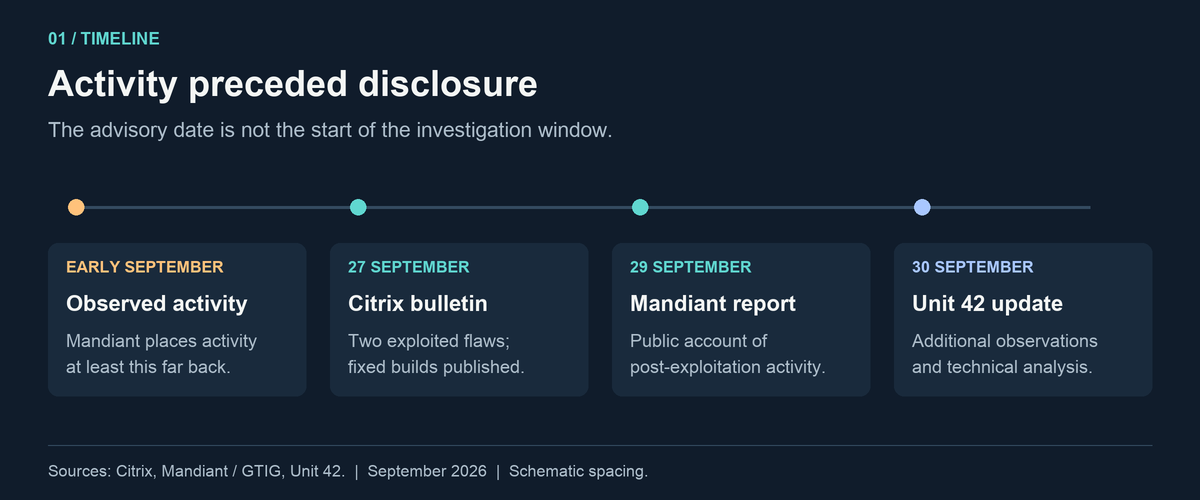
Figure 1. Observation dates and publication dates answer different questions. Original illustration based on Mandiant/GTIG, Citrix and Unit 42; spacing is schematic.
Start the review from the earliest relevant exposure and available evidence. A search beginning on the advisory date would miss the earlier activity described here. If retention does not cover that period, record the gap explicitly; an empty search cannot resolve it.
A familiar-looking file can hide a different job
Unit 42’s investigation provides a separate view of the activity. Its account includes PHP webshells stored with .deb extensions. It also describes a 21 September intrusion associated with CVE-2026-88771, where a hidden implant was made accessible through paths resembling CSS assets.
The useful detail is the web-server configuration. A file extension does not determine how the server executes a file when its handlers and aliases have been changed. A request that looks like a stylesheet download can therefore deserve closer inspection. Unit 42 also documents changes intended to preserve elevated command execution.
For an investigator, this argues for comparing configuration as well as files. Ask whether the current web-server settings match a trusted baseline for that build. Identify who approved deviations. A known hash can find a known implant, but an unexplained handler change remains worth investigating when the payload has a different name.
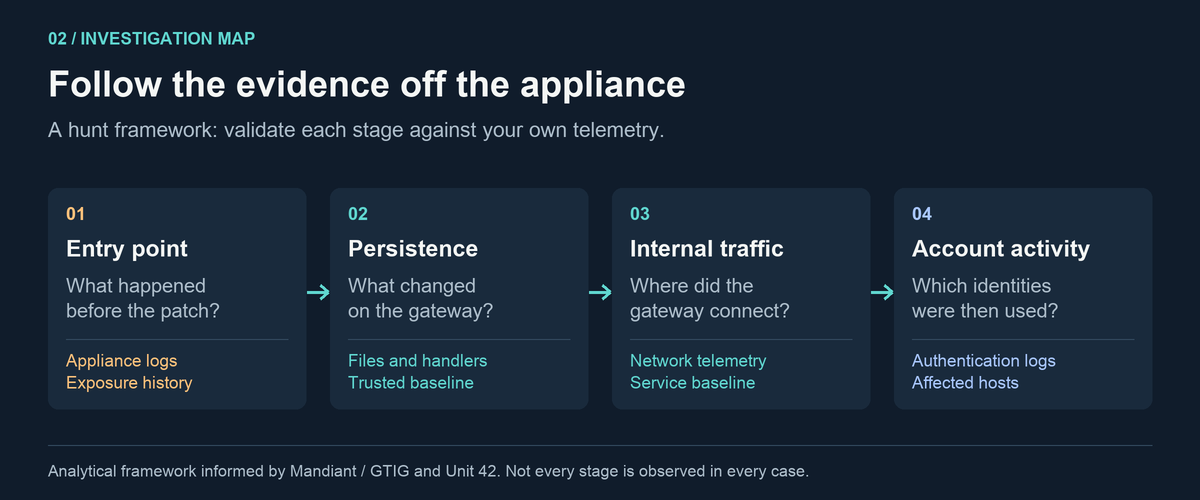
Figure 2. An investigation map, not a claim that every victim experienced every stage. Original illustration informed by the Mandiant/GTIG and Unit 42 reports.
What to put in front of an analyst
The CERT-FR alert highlights a useful pair of artifacts reported by Google: a DTLS handshake failure with an internal-error reason, followed by abnormal NSPPE packet-engine termination and a watchdog message indicating that the process was not restarted. CERT-FR also links to Google’s indicators and YARA rules, while noting that ANSSI has not qualified them.
Treat that combination as a hunting lead. A single crash or handshake error needs context. Correlate the appliance, virtual server and time with subsequent configuration changes, requests and outbound traffic. Check how timestamps were normalized before assuming two events happened in sequence.
For the internal side, a practical starting point is traffic originating from the appliance towards services it does not normally contact. Review authentication events around those connections, then follow any accounts or hosts that appear. Keep the baseline specific to the deployment: monitoring, directory integration and administration can all generate legitimate connections.
These are investigation hypotheses, not validated detection rules. Before turning them into alerts, establish which logs are actually collected, how quickly they arrive and what normal maintenance looks like. A proposed correlation is of little use if one of its inputs never reaches the SIEM.
Close the exposure, then establish the scope
CERT-EU recommends updating affected software and assessing internet-exposed appliances for compromise. Those are two separate workstreams with different completion criteria.
The update workstream should produce evidence of the installed build on each relevant appliance. The investigation should produce a timeline, a record of the evidence examined and an explanation of any remaining uncertainty. If compromise is suspected, involve the incident-response team and preserve evidence in parallel with containment; urgent isolation should not wait for a perfect collection.
Avoid using service availability as the closure test. A functioning VPN says little about earlier access. Likewise, an assessment of one cluster member should not silently become an assessment of the whole deployment.
Conclusion
For these disclosures, the most useful CTI output is a set of questions the SOC can answer: when was the gateway exposed, what changed on it, and where did its connections lead?
Keep those answers beside the patch record. If the available evidence cannot answer one of them, document the limitation and assign the next action. That leaves the team with an investigation it can defend, rather than a maintenance ticket carrying an unsupported assumption of recovery.
Sources
- Citrix — Security bulletin CTX697096, 27 September 2026
- Mandiant / GTIG — Defending Against Active Exploitation of Citrix NetScaler ADC and Gateway Appliances, 29 September 2026
- Unit 42 — NetScaler zero-day threat brief, updated 30 September 2026
- CERT-FR — CERTFR-2026-ALE-011, updated 30 September 2026
- CERT-EU — Security Advisory 2026-014